
What Waiting Another Season Actually Costs You
A worn spring doesn't send you a warning text. It either lets go quietly, leaving your door stuck shut (bad if a storm is rolling in and you need the car out), or it snaps with enough force to dent the door, bend the track, or send a cable whipping loose. Either way, what would have been a planned spring replacement turns into an emergency call, usually at the worst possible time — during a hailstorm, a heat wave, or when you're trying to get the kids to school. The springs do almost all the lifting work on your door; the opener motor just guides it. When they weaken, everything downstream — cables, rollers, the opener itself — starts absorbing stress it wasn't built for, and those parts wear out faster too.
Here's a walkthrough you can do in fifteen minutes, with what each sign means if it shows up.
The Garage Door Spring Checklist
1. Look at the torsion spring coils
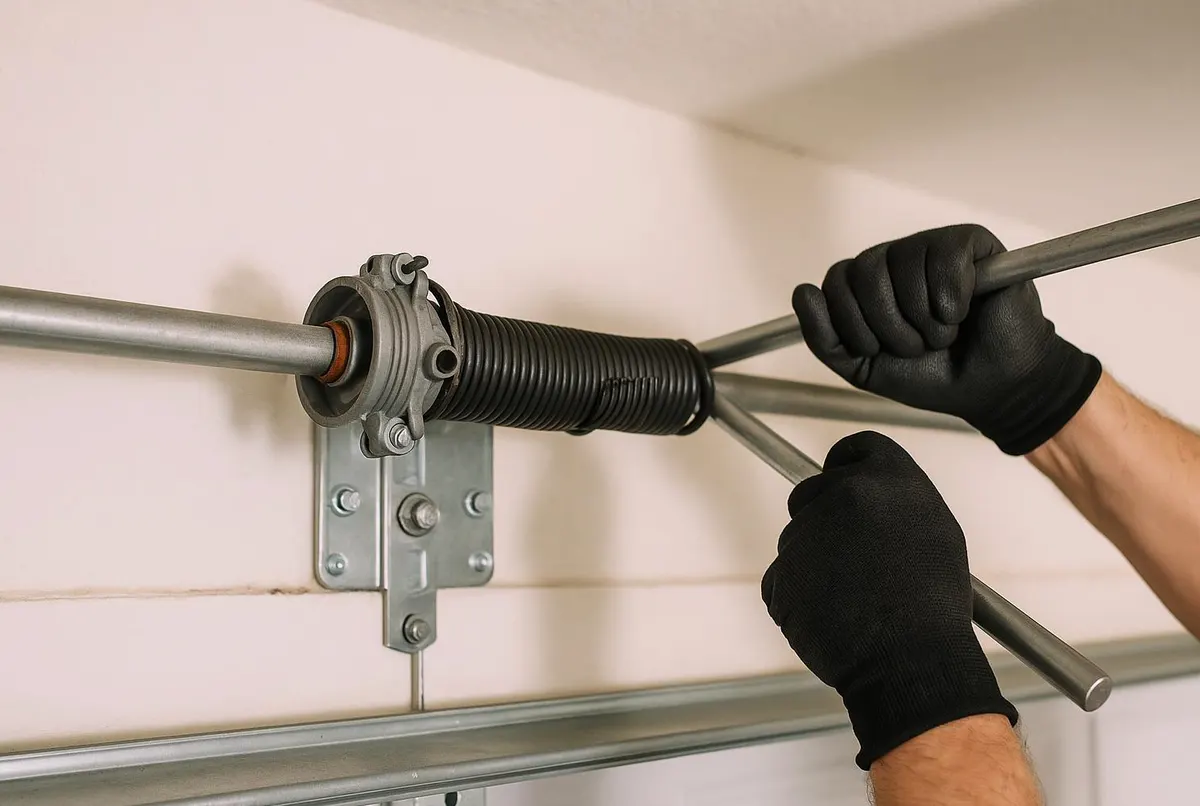
If you have one or two springs mounted horizontally above the door on a metal shaft, that's a torsion system. Look for gaps between coils that are wider in one spot than the rest, or a coil that looks twisted out of line. A visible gap usually means the spring has already fractured internally — it may still be holding the door up, barely, but it's running on borrowed time.
2. Check extension springs for stretching or frayed strands
Extension springs run along the horizontal tracks and stretch as the door moves. Compare both springs side by side — if one looks noticeably longer or more stretched out than the other, it's lost tension. Frayed or separated strands anywhere along the coil are a sign the metal is fatiguing and close to giving out.
3. Do the manual balance test
Disconnect the opener by pulling the red release cord, then lift the door by hand to waist height and let go. A properly balanced door with healthy springs will stay put. If it drifts down, slams shut, or shoots upward on its own, the springs are no longer carrying their share of the weight — a strong early warning sign, even before you see physical damage.
4. Listen for new noises during a normal open/close cycle
A loud bang, a metallic pop, or a grinding sound you haven't heard before often means a spring coil is catching or starting to separate. Occasional squeaks are usually just dry rollers or hinges, but any sharp, sudden noise during operation is worth pausing on and getting looked at.
5. Watch how hard the opener is working
If the door seems to hesitate before it starts moving, closes slower than it used to, or the opener motor sounds strained, the springs are likely underperforming and the motor is compensating. This shortens the life of the opener itself, turning a spring problem into a two-part repair if it's ignored.
6. Check for rust or corrosion on the coils
Humidity swings, dust, and road grit from unpaved or gravel driveways common around Von Ormy and Lytle properties can settle into spring coils over time. Surface rust weakens the metal gradually and makes it more likely to snap under tension rather than wear predictably. A light coat of garage door lubricant on the coils can slow this down if caught early.
7. Look at how the door sits when fully open or closed
If one side of the door looks higher than the other, or the door tilts visibly as it moves, one spring is likely carrying more load than the other. This uneven stress accelerates failure on the weaker side and can also throw off the tracks and rollers.
8. Count the cycles, or at least the years
Standard torsion springs are typically rated for somewhere in the range of 10,000 cycles, which for an average household works out to several years of daily use — fewer if the door gets heavy use for work vehicles, livestock trailers, or equipment. If you can't remember the last time your springs were replaced and it's been close to a decade, treat that as reason enough to have them checked, regardless of how they look.
Why This Matters More Going Into Texas Storm Season
Sudden severe storms and hail can mean more opening and closing in a short window — getting vehicles under cover, checking on livestock, moving equipment — which puts extra cycles on springs that may already be near the end of their life. Long, hot summers cause metal to expand and contract repeatedly, and dust and wind-blown debris work their way into the coils over time. None of that causes a spring to fail on its own, but it does speed up wear that's already started, which is exactly why catching the early signs matters.
When to Call Von Ormy Garage Door
If your door fails the balance test, you spot a visible gap in the coils, or you hear a new bang or pop during operation, stop using the opener and call us before the spring finishes failing on its own schedule. We handle spring replacement for both torsion and extension systems, matched to your door's actual weight and cycle needs, not a one-size-fits-all part. If the opener has been straining for a while, we'll check it during the same visit and handle garage door opener repair if it's been damaged by the extra load. For anything that's already let go, our emergency garage door service covers Von Ormy and the surrounding area so you're not stuck waiting with a door that won't open or close.
If any of the checks above didn't look right in your garage, give Von Ormy Garage Door a call. We serve Von Ormy, TX and nearby communities, and we'd rather replace a tired spring on your schedule than on its own.